
*By the AC Specialists at R & Y A/C Compressors | Family-owned and operated in Miami, FL since 1989 | Last updated: July 2026*
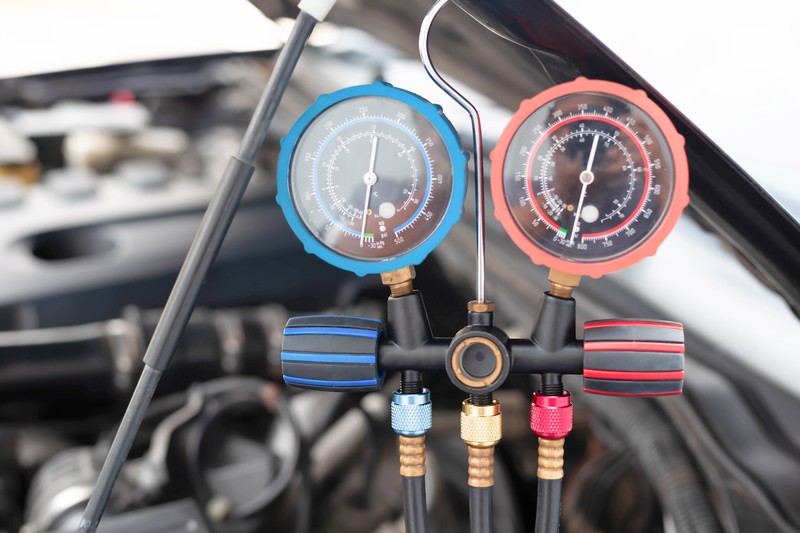
Learning how to test car AC pressure can help you identify common air conditioning problems before replacing expensive components. A manifold gauge set lets you compare low-side and high-side pressures while the system operates. Those readings can help identify low refrigerant, excessive pressure, restrictions, condenser problems, or a weak compressor.
What You Need to Test Car AC Pressure
You only need a few tools for a basic pressure test:
Manifold gauge set: Use gauges and couplers designed for your vehicle’s refrigerant. R-134a and R-1234yf systems use different service fittings.
Thermometer: Check both outdoor temperature and vent temperature.
Safety glasses and gloves: Refrigerant can cause severe cold burns if it contacts your skin or eyes.
Underhood AC label: This identifies the refrigerant type and specified charge amount.
A low-side gauge from a typical recharge kit only provides part of the information. Comparing both sides can help identify problems involving the expansion valve, condenser, or compressor.
Finding the High and Low Service Ports
Your vehicle has two AC service ports. They have different sizes to help prevent incorrect connections.
The low-side port is usually on the larger AC line between the evaporator and compressor. It may be near the accumulator or along the engine compartment.
The high-side port is normally located on the smaller line between the compressor and condenser. The caps are often marked “L” and “H.”
If you are unsure about the locations, follow the AC lines from the compressor. The larger suction line is the low side, while the smaller discharge line becomes hot when the AC is operating.
R-1234yf systems use different coupler dimensions. Do not force R-134a equipment onto an R-1234yf system.
How to Hook Up a Manifold Gauge Set
Follow these steps when testing AC pressure:
Turn the engine off. Park on level ground and keep the engine off while connecting the gauges.
Close both manifold valves. Keep the blue and red valves closed during a pressure test.
Remove the service port caps. Check for oil residue around the ports, which may indicate a leak.
Connect the blue hose to the low side. Lock the coupler securely onto the service port.
Connect the red hose to the high side. Make sure the connection is secure before starting the engine.
Record static pressure. Check both gauges before starting the engine.
Start the engine. Set the AC to maximum cooling, turn the blower to high, and use recirculation.
Let the system stabilize. Allow two or three minutes for the pressures to settle.
Check the gauges. Take readings at idle and again around 1,500 to 2,000 RPM.
Disconnect carefully. Turn the engine off, release the couplers, and reinstall the service port caps.
Keep both manifold valves closed when you are only testing pressure. Opening the valves changes the flow of refrigerant and can create an unsafe condition.
Static Pressure vs. Running Pressure
Static pressure is measured with the engine off after the refrigerant has had time to equalize. Both gauges should show approximately the same pressure.
For R-134a, static pressure can be around 70 psi at 70°F, 92 psi at 85°F, and 108 psi at 95°F. These figures are approximate and can vary.
A very low static reading can indicate substantial refrigerant loss. However, a normal static reading does not prove that the system has a full charge. A system can still be significantly undercharged while showing reasonable static pressure.
Running pressure provides more useful diagnostic information. When the compressor operates, the low side should drop while the high side rises. The difference between the two readings helps indicate how well the compressor and other AC components are functioning.
If your readings are unusual, our AC gauge readings guide explains common pressure combinations.
Normal AC Pressure Readings for R-134a and R-1234yf
The following ranges are general guidelines for a properly functioning system operating around 1,500 RPM with maximum AC:
These are not universal specifications. Vehicle design, humidity, compressor type, condenser airflow, and refrigerant charge can all affect pressure.
R-1234yf systems operate within similar pressure ranges, but you should always use specifications for the particular vehicle.
If your system is simply low, do not stop at adding refrigerant. A refrigerant leak should be found and repaired first. Our guides on how to recharge car AC and finding car AC refrigerant leaks can help.
Adjusting AC Pressure Readings for Ambient Temperature
Ambient temperature has a major effect on AC pressure. A reading that seems high on a 100°F afternoon may be normal on a hot day but excessive at 70°F.
As a general reference, the high side often increases as outdoor temperature rises. Low-side pressure can also increase somewhat with higher temperatures.
Condenser airflow matters, too. Make sure the condenser fans operate during your test. A failed fan can cause high-side pressure to climb significantly, especially while the vehicle is stationary.
Do not diagnose a compressor from one gauge reading alone. Compare the low and high sides and consider ambient temperature before deciding which component has failed.
AC Pressure Testing Safety Rules
Refrigerant systems operate under pressure, so take the following precautions:
Wear safety glasses and gloves. Liquid refrigerant can cause serious frostbite.
Never intentionally release refrigerant. R-134a and R-1234yf must be recovered with appropriate equipment.
Keep hoses away from belts and fans. Secure them before starting the engine.
Do not open the high-side valve while charging. High-side pressure can be dangerous.
Use equipment rated for the refrigerant in the vehicle.
Keep R-1234yf away from ignition sources. It is mildly flammable.
Take extra care with hybrid vehicles. Electric compressors and high-voltage systems can require different procedures and oil specifications.
Hybrid systems can use POE oil rather than the PAG oil found in many conventional systems. Our hybrid electric AC compressor guide explains some of these differences.
Frequently Asked Questions
Static pressure depends on the ambient temperature. For R-134a, it may be around 70 psi at 70°F and 92 psi at 85°F. Both gauges should generally show similar readings after the system equalizes.
At approximately 85 to 90°F, a healthy system may show around 30 to 40 psi on the low side and 200 to 250 psi on the high side. Vehicle specifications and weather conditions can change these readings.
A low-side gauge can help identify a severely low system, but it cannot give you the complete picture. Both low-side and high-side readings are more useful for diagnosing compressor, restriction, and condenser problems.
This combination can indicate that the compressor is not creating enough pressure difference. A worn compressor can cause this pattern. Confirm that the clutch is fully engaging and that other system problems have been ruled out before replacing the compressor.
R-1234yf systems use different service couplers, so you need equipment designed for R-1234yf. Never force an R-134a coupler onto an R-1234yf service port.
Some systems naturally cycle the compressor on and off. Rapid cycling every few seconds can indicate a low refrigerant charge or another problem. Our guide to AC compressor short cycling covers common causes.