
*By the AC Specialists at R & Y A/C Compressors | Family-owned and operated in Miami, FL since 1989 | Last updated: March 2026*
Quick Answer:
Common Ford F-150 AC problems include compressor clutch bearing failure on the 12th gen, compressor failures on 3.5L EcoBoost trucks around 80,000–120,000 miles, and blend door actuator issues often misdiagnosed as compressor problems. Total replacement cost runs $705–$1,445 with a remanufactured compressor. Always check the blend door actuator before committing to a compressor replacement.
The Ford F-150 is America’s best-selling vehicle, and it is not hard to see why. These trucks work hard, whether hauling loads on a job site, towing trailers, or serving as a daily driver. But all that hard work generates heat, and when the AC stops keeping up, things get uncomfortable fast, especially during summer.
The AC compressor on the F-150 handles a big job. The cabin is larger than most sedans, and the engine bay runs hot. This guide covers the most common AC problems across recent F-150 generations, how to troubleshoot them, and what replacement costs look like in 2026.
Common Ford F-150 AC Issues by Generation
12th Generation (2009-2014)
The 12th-gen F-150 brought significant changes including the available EcoBoost engines. AC issues on these trucks include:
- Compressor clutch bearing failure: A common complaint on higher-mileage trucks. The clutch bearing makes a whining or squealing noise that increases with engine speed and may change pitch when the AC is engaged. If caught early, the bearing can sometimes be replaced without changing the entire compressor.
- Leak at the compressor manifold: The point where the refrigerant lines connect to the compressor body uses O-rings that harden and shrink over time, causing slow leaks.
- Blend door actuator failure: This is the most common AC-related complaint on 12th-gen F-150s, and it is not a compressor issue at all. The blend door actuator makes a clicking or ticking sound behind the dash and fails to properly direct airflow between hot and cold. This causes inconsistent temperatures and is often misdiagnosed as a compressor problem.
- Low refrigerant from condenser leaks: The condenser sits behind the grille and takes a beating from road debris, bugs, and rocks. Small punctures cause slow refrigerant loss.
13th Generation (2015-2020)
The aluminum-body 13th-gen F-150 is lighter and more efficient, but the AC system still deals with the challenges of a full-size truck:
- Compressor failure on 3.5L EcoBoost: The twin-turbo 3.5L generates significant underhood heat, and the AC compressor works harder as a result. Some owners report compressor failures between 80,000 and 120,000 miles.
- Dual-zone climate control issues: Trucks equipped with dual-zone automatic climate control can experience temperature discrepancies between driver and passenger sides. This is typically a blend door or temperature sensor issue rather than a compressor problem.
- AC performance drop during towing: When towing heavy loads, the engine works harder and underhood temperatures rise. The condenser, which shares the front of the vehicle with the radiator and intercooler, may not get enough airflow to reject heat efficiently. This can cause the AC to blow warmer than normal during heavy towing, particularly in stop-and-go traffic.
- Refrigerant line connections: The screw-together line connections used on some 13th-gen models can loosen over time due to vibration, causing slow leaks.
14th Generation (2021-Present)
The current F-150 lineup includes both traditional gas engines and the hybrid PowerBoost, as well as the all-electric Lightning:
- R-1234yf refrigerant: All 14th-gen F-150s use R-1234yf, which is more expensive to service than the older R-134a.
- Hybrid and electric AC considerations: The PowerBoost hybrid and F-150 Lightning use electric AC compressors. These operate independently of the engine and have different failure modes, including inverter failures and high-voltage wiring issues.
- Software-controlled AC management: Modern F-150s use sophisticated software to manage AC compressor engagement, and software glitches can sometimes cause AC performance issues that are fixed with a dealer software update.
Troubleshooting F-150 AC Problems
Here is a systematic approach to figuring out why your F-150’s AC is not performing.
Quick Checks (No Tools Required)
Start with these before pulling out any equipment:
- Check the cabin air filter. On the F-150, the cabin air filter is located behind the glove box. A clogged filter dramatically reduces airflow and cooling performance. Replace it if it is dirty.
- Inspect the condenser. Look through the grille for visible damage, debris buildup, or bent fins. A condenser caked with bugs, mud, or leaves cannot reject heat properly.
- Listen for the compressor clutch. With the engine running and AC on max, listen for the clutch engagement sound. No click means the compressor is not engaging.
- Check for obvious leaks. Look for oily residue on the compressor, hoses, and condenser. Refrigerant oil escapes with the refrigerant, leaving visible traces.
Intermediate Diagnostics
- Verify refrigerant charge with gauges. Connect a manifold gauge set to the service ports. Normal pressures for an F-150 at idle with 85-degree ambient temperature:
– Low side: 30 to 40 psi
– High side: 225 to 275 psi
- Check cooling fan operation. The F-150’s electric cooling fans should ramp up when the AC is on. If the fans are not running or running at low speed, condenser performance suffers and pressures will be high.
- Test the compressor clutch circuit. Check for 12 volts at the compressor clutch connector with the AC commanded on. If voltage is present but the clutch does not engage, the clutch coil or clutch assembly is faulty. If voltage is not present, trace the circuit back through the relay, fuse, and pressure switches.
Pressure Reading Interpretation for the F-150
| Condition | Low Side | High Side | What It Means |
| Normal operation | 30-40 psi | 225-275 psi | System working correctly |
| Low charge | Below 25 psi | Below 200 psi | Refrigerant leak somewhere |
| Blocked expansion valve | Very low or vacuum | High or normal | Expansion valve stuck closed |
| Compressor not compressing | Above 50 psi | Below 150 psi | Internal compressor failure |
| Condenser restriction or no fan | Normal | Above 300 psi | Airflow problem or overcharge |
| Compressor not engaging | Equal (static) | Equal (static) | Clutch, electrical, or low charge |
The Blend Door Actuator Test
Since blend door actuator failures are so common on F-150s, test this before assuming the compressor is bad:
- Turn the engine on and set the temperature to full cold
- Listen behind the center of the dashboard for a clicking or ticking sound
- Change the temperature setting from cold to hot and back
- If you hear clicking and the temperature does not change as expected, the blend door actuator has likely failed
Replacing a blend door actuator on an F-150 typically costs $150 to $400, far less than a compressor replacement. It is important to rule this out first.
F-150 AC Compressor Replacement
Parts Required
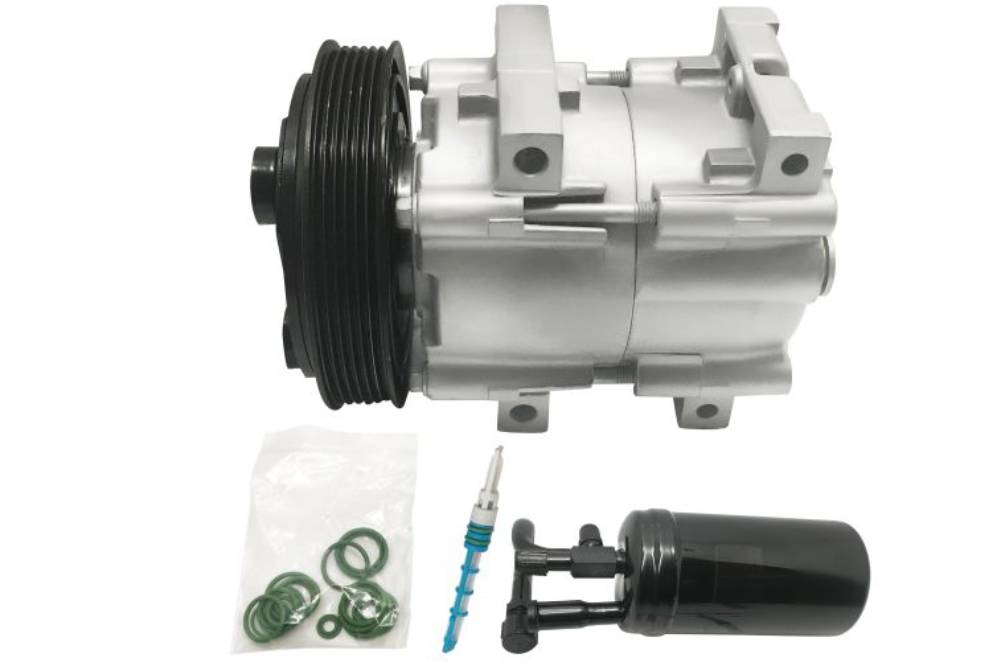
- AC compressor: Specific to your F-150’s engine and model year
- Accumulator/drier: The F-150 uses a suction line accumulator rather than a receiver/drier. Replace it every time the system is opened.
- Orifice tube: Located in the liquid line. Replace it, especially if the old compressor failed internally. Check for debris in the old tube to confirm internal failure.
- Compressor oil (PAG): Correct viscosity and quantity per Ford specifications
- Refrigerant: R-134a or R-1234yf depending on model year, charged to spec
- O-rings: New O-rings for all disturbed connections
- Condenser: Replace if the compressor had an internal failure
What Makes F-150 Compressor Replacement Different
Several factors make the F-150 compressor job unique compared to smaller vehicles:
- Engine variety: The F-150 comes with multiple engine options (3.3L V6, 2.7L EcoBoost, 3.5L EcoBoost, 5.0L V8, PowerBoost hybrid, and the electric Lightning). The compressor mounting, belt routing, and line connections differ by engine.
- Underhood space: Despite being a large truck, the engine bay on EcoBoost models is packed tight with turbo plumbing, intercooler piping, and emissions equipment. Access to the compressor can be challenging.
- Rear AC systems: F-150s with rear climate control have a longer refrigerant circuit with additional components. When replacing the compressor on a dual-zone truck, ensure the rear expansion valve and evaporator are also inspected.
- Higher refrigerant capacity: The F-150’s AC system holds more refrigerant than a sedan, which means higher charging costs, especially with R-1234yf.
Labor Time
Expect 3 to 5 hours of labor for a straightforward compressor replacement on a V8 or naturally aspirated V6. EcoBoost models may add an hour due to tighter access. If additional components like the condenser are being replaced simultaneously, add another 1 to 2 hours.
Ford F-150 AC Compressor Replacement Cost
| Item | Cost Range |
| Remanufactured compressor | $250 – $500 |
| New OEM compressor | $450 – $800 |
| Accumulator/drier | $30 – $70 |
| Orifice tube | $10 – $25 |
| Refrigerant and oil | $50 – $120 |
| O-rings | $15 – $30 |
| Labor (3-5 hours) | $350 – $700 |
| Total (with reman compressor) | $705 – $1,445 |
| Total (with new OEM) | $905 – $1,745 |
Dealership prices will be at the higher end or above these ranges. An independent shop experienced with Ford trucks is usually your best value.
Keeping Your F-150 AC Running Strong
- Clean the condenser annually. Use a garden hose (not a pressure washer, which can bend fins) to wash debris off the condenser, especially if you drive on dirt roads or in areas with heavy insects.
- Run the AC year-round. Even in winter, engage the AC periodically to circulate oil through the compressor and keep seals lubricated.
- Do not ignore small leaks. A system that needs a recharge every year has a leak. Find it and fix it before it leads to compressor damage from low oil circulation.
- Address cooling fan issues promptly. A cooling fan that is not working properly affects both engine cooling and AC performance.
- Keep up with belt maintenance. A worn or loose serpentine belt reduces compressor performance and can cause slipping under heavy AC load.
Frequently Asked Questions
With a remanufactured compressor at an independent shop, expect $705–$1,445 total. With a new OEM compressor, the total is $905–$1,745. EcoBoost models add labor time due to tighter engine bay access. Dealership prices run higher. Check for condenser replacement needs if the compressor failed internally, which adds $200–$400.
ntermittent AC on an F-150 is commonly caused by a low refrigerant charge (which trips the low-pressure switch and cuts off the compressor), a faulty blend door actuator, or a failing compressor clutch relay. It can also result from an overheating condenser if the electric cooling fans are not functioning. Start with a refrigerant charge check and a blend door actuator test.
The blend door actuator is a small electric motor that controls a door (blend door) inside the HVAC plenum. This door mixes hot and cold air to reach your desired temperature. When the actuator fails on an F-150, it often makes a clicking or ticking sound behind the dashboard and may get stuck in one position, blowing only hot or only cold air regardless of your temperature setting.
Yes — blend door actuator failure is the most-reported AC complaint across multiple F-150 generations. The actuator is a relatively inexpensive part ($30–$80) but requires dashboard disassembly to replace. Condenser leaks from road debris are also common on trucks driven in rocky or debris-heavy environments. Compressor failures occur on EcoBoost models at higher mileage.
F-150s through the 2020 model year generally use R-134a. The 14th-gen F-150 (2021 and newer) uses R-1234yf. Check your underhood AC label to confirm the refrigerant type and system capacity for your specific truck. The service port fittings are different for the two refrigerants and prevent accidental cross-contamination.
Remove the orifice tube from the liquid line and inspect it. If you find metallic debris or a dark/black coating on the screen, the compressor has failed internally and sent metal particles through the system. Also listen for grinding or knocking from the compressor when the AC is running. If internal failure is confirmed, replace the condenser and orifice tube along with the compressor.
A DIY replacement is feasible on naturally aspirated V6 and V8 models with basic mechanical experience and AC service equipment (recovery machine, vacuum pump, manifold gauges, refrigerant scale). EcoBoost models have tighter access and are more challenging. The refrigerant must be recovered before opening the system — you cannot legally vent it to the atmosphere.
Get Your F-150 AC Compressor from R & Y A/C Compressors
R & Y A/C Compressors has been equipping trucks with quality AC parts since 1989. We carry compressors for every F-150 engine option, from the 5.0L V8 to the EcoBoost lineup. Our remanufactured units are tested and warrantied, giving you reliable cooling at a price that makes sense. Search our catalog at rycompressors.com by year and engine, or contact our Miami team for expert guidance on getting the right parts for your F-150.