
*By the AC Specialists at R & Y A/C Compressors | Family-owned and operated in Miami, FL since 1989 | Last updated: March 2026*
Quick Answer:
Jeep Wrangler AC systems work harder than most due to poor insulation, off-road low-speed operation (no condenser airflow), and trail debris exposure. JK (2007–2018) compressors commonly fail from bearing wear and evaporator leaks. JL (2018+) compressors are more capable but still vulnerable to condenser damage. Total replacement cost runs $635–$1,380 with a remanufactured compressor. Test with the hardtop on — soft tops mask true system performance.
The Jeep Wrangler is built for adventure. It handles trails, river crossings, and open-air driving better than anything else on the market. But when it comes to keeping the cabin cool, the Wrangler faces unique challenges that other vehicles simply do not have.
The removable top, fold-down windshield, less insulation, and open-air design all work against the AC system. Add in the heat generated by off-road driving at low speeds and the exposure to dust, water, and mud, and you have a vehicle that demands more from its AC compressor than most. This guide covers the specific AC challenges Wrangler owners face, common compressor problems by generation, and everything you need to know about replacement.
Why Wrangler AC Systems Work Harder
Before diving into specific problems, it helps to understand why the Wrangler’s AC system has a tougher job than most.
Less Insulation, More Heat Gain
The Wrangler’s body is designed for modularity, not thermal efficiency. The soft top and hardtop both provide less insulation than a conventional vehicle roof. The thin body panels, removable doors, and large glass area all allow heat to enter the cabin more easily. The AC system has to overcome significantly more heat gain than a conventional SUV of similar size.
Off-Road Operating Conditions
When crawling over rocks at 3 mph in low range on a 95-degree day, the engine is working hard but vehicle speed is near zero. That means almost no airflow across the condenser. The AC system struggles to reject heat, and the compressor works harder. This is the exact opposite of what the AC system was designed for (highway speeds with ample airflow).
Dust, Water, and Debris Exposure
Wranglers go places other vehicles cannot, and the AC components pay the price. The condenser gets clogged with trail dust. Electrical connectors get splashed during water crossings. The compressor and its wiring are exposed to more environmental abuse than on a typical road vehicle.
Common Jeep Wrangler AC Problems by Generation
JK Generation (2007-2018)
The JK Wrangler is the most common Wrangler on the road today, and its AC system has well-documented issues.
#### Compressor Failure
The JK uses a fixed-displacement compressor that is adequate for normal driving but can be overwhelmed in extreme conditions. Common failure modes include:
- Internal bearing failure: Produces a grinding or knocking noise when the clutch is engaged. Often caused by inadequate oil circulation from low refrigerant charge.
- Reed valve failure: The compressor loses its ability to maintain proper pressure differential. Low side pressure rises above normal, high side drops below normal, and cooling capacity decreases dramatically.
- Clutch burnout: The electromagnetic clutch coil burns out from overwork, particularly on vehicles that spend a lot of time in hot, slow-speed conditions.
#### Condenser Damage
The JK’s condenser sits behind the grille and is exposed to everything the trail throws at it. Rock impacts, mud packing, and bug buildup all degrade condenser performance. Some JK owners install aftermarket condenser guards to protect against trail damage.
#### Evaporator Leaks
A known issue on JK Wranglers is evaporator leaks. The evaporator is located inside the dash, and replacing it requires significant dashboard disassembly. Unfortunately, the JK evaporator is prone to developing leaks at the seams, especially in vehicles driven in humid coastal environments where corrosion is accelerated. This is an expensive repair due to the labor involved.
#### Refrigerant Line Routing
The JK’s refrigerant lines run in areas exposed to trail hazards. Lines can be damaged by rocks, branches, or aftermarket accessories that are mounted without regard for the AC plumbing. Even a small nick in an aluminum line will eventually become a leak.
JL Generation (2018-Present)
The JL Wrangler brought significant improvements, including the switch from the old 3.6L Pentastar-only lineup to multiple engine options and a more modern climate control system.
#### Improved but Not Immune
The JL’s AC system is more capable than the JK’s, with better airflow management and a more efficient compressor. However, owners still report issues:
- AC performance in extreme heat: When ambient temperatures exceed 100 degrees Fahrenheit and the vehicle is at low speed or idling, the AC may struggle to keep the cabin below 80 degrees, especially with a soft top.
- Condenser leaks: Still a common issue, though the JL’s condenser is somewhat more protected than the JK’s.
- Compressor noise at startup: A brief chirp or squeal when the compressor first engages, usually caused by belt slip. Keeping the belt properly tensioned resolves this in most cases.
#### 2.0L Turbo Considerations
The JL equipped with the 2.0L turbocharged four-cylinder generates more underhood heat than the naturally aspirated 3.6L. Some owners report slightly reduced AC performance during sustained high-load conditions like towing or aggressive off-roading.
#### 4xe Hybrid
The Wrangler 4xe uses an electric AC compressor that operates independently of the gas engine. This is actually an advantage for AC performance because the compressor maintains consistent operation regardless of engine load. However, the electric compressor has its own failure modes related to the high-voltage electrical system.
Diagnosing Wrangler AC Problems
Quick Visual Inspection
Start with a thorough visual check, which is especially important on a Wrangler that sees off-road use:
- Condenser condition: Look through the grille for mud, debris, bent fins, and damage. Clean the condenser with a garden hose if it is dirty. Do not use a pressure washer, as high pressure will bend the fins.
- Refrigerant line condition: Inspect all visible lines for dents, scrapes, and leaks. Pay attention to areas where aftermarket accessories like light bars or winches may have been mounted near AC lines.
- Electrical connections: Check the compressor clutch connector for corrosion, especially if the Wrangler is used for water crossings. Apply dielectric grease to prevent future corrosion.
- Belt condition and tension: A worn or loose serpentine belt will slip when the compressor engages, reducing or eliminating cooling.
Pressure Testing
Connect a manifold gauge set and compare to these typical values for a Wrangler (3.6L Pentastar, 85-degree ambient, idle):
- Low side: 28 to 38 psi
- High side: 200 to 260 psi
Note that pressures will run higher than these values in extreme ambient temperatures or at low vehicle speeds with poor condenser airflow. If pressures are elevated during off-road use, that may be normal behavior for the conditions rather than a system fault.
Common Pressure Scenarios
- Both pressures low: System is short on refrigerant. Find and fix the leak.
- Low side high, high side low: Compressor is not compressing. Internal failure confirmed.
- High side very high (above 300 psi): Condenser airflow is restricted (dirty condenser, failed fan, or blocked by aftermarket bumper). Could also be an overcharge.
- Low side in vacuum: Blockage in the orifice tube or expansion valve. Debris from a failing compressor is a common cause.
Wrangler-Specific Diagnostic Tips
- Test with the hardtop on if possible. Soft tops allow so much heat gain that vent temperatures may be higher than expected even with a perfectly functioning system. Testing with a hardtop provides a better baseline.
- Test at highway speed. The Wrangler’s AC performs best with good condenser airflow. If the AC works well at 60 mph but poorly in a parking lot, the issue is likely condenser-related (dirty, blocked, or fan not working) rather than compressor-related.
- Check for aftermarket interference. Bull bars, steel bumpers, light bars, and winches can restrict airflow to the condenser or physically interfere with AC components. If AC problems started after installing aftermarket accessories, that is a strong clue.
Jeep Wrangler AC Compressor Replacement
Parts Needed
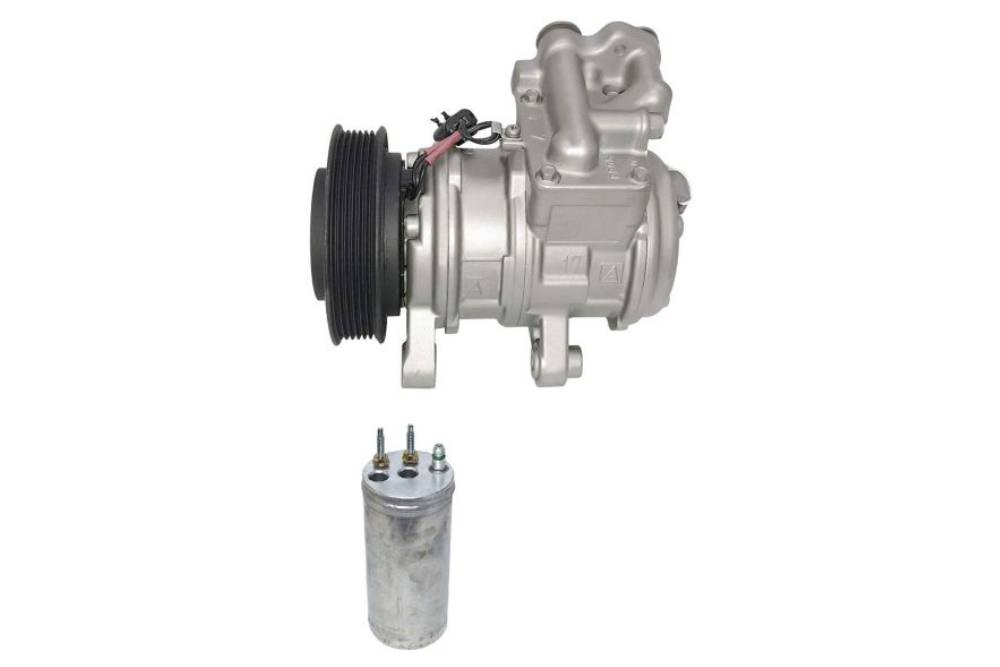
- AC compressor: Specific to your Wrangler’s engine and model year
- Receiver/drier or accumulator: Replace every time the system is opened
- Expansion valve or orifice tube: Replace during compressor replacement
- Compressor oil (PAG): Correct viscosity for your system
- Refrigerant: R-134a for most JK models, R-1234yf for most JL models (verify on your underhood label)
- O-ring kit: New seals for all connections
- Condenser: If the compressor failed internally, or if the existing condenser is damaged
Replacement Challenges on the Wrangler
- Compressor access: On the 3.6L Pentastar V6, the compressor is accessible from below the vehicle. The 2.0L turbo model has tighter clearances.
- Line routing: The Wrangler’s lines must be carefully routed to avoid contact with suspension components and frame rails, especially after a lift kit installation.
- Aftermarket modifications: Wranglers with lift kits, engine swaps, or extensive aftermarket modifications may have non-standard component locations that add complexity to the job.
- Evacuation time: Due to the potential for moisture intrusion (especially on vehicles that have been through water crossings with compromised seals), pull a thorough vacuum of at least 45 minutes.
Labor Time
Expect 3 to 5 hours for a compressor replacement on a stock Wrangler. Modified vehicles may require additional time.
Jeep Wrangler AC Compressor Replacement Cost
| Item | Cost Range |
| Remanufactured compressor | $225 – $475 |
| New OEM compressor | $400 – $750 |
| Receiver/drier | $25 – $65 |
| Expansion valve | $25 – $60 |
| Refrigerant and oil | $45 – $100 |
| O-rings | $15 – $30 |
| Labor (3-5 hours) | $300 – $650 |
| Total (with reman compressor) | $635 – $1,380 |
| Total (with new OEM) | $810 – $1,655 |
Maximizing AC Performance on Your Wrangler
Even with a perfectly functioning AC system, you can take steps to improve cooling:
- Choose a hardtop for summer driving if you own both tops. The insulation difference is significant.
- Use sunshades on the windshield when parked. The Wrangler’s large, upright windshield is a major heat entry point.
- Tint the windows (within legal limits). Quality window tint reduces solar heat gain substantially.
- Keep the condenser clean. After every off-road trip, rinse the condenser with clean water.
- Consider a condenser guard if you do serious trail driving. The small airflow penalty is worth the protection from rock damage.
- Apply dielectric grease to all exposed AC electrical connectors to prevent corrosion from water exposure.
- Do not forget the recirculate button. Using recirculated cabin air instead of pulling in hot outside air dramatically improves cooling performance.
Frequently Asked Questions
Wranglers are inherently harder to cool than conventional vehicles due to poor insulation, large glass areas, and an open body design. If the AC was previously adequate but has declined, the most likely causes are low refrigerant charge from a condenser leak or line damage, a dirty/blocked condenser, or a compressor that is not building adequate pressure. Test at highway speed with the hardtop on to establish a baseline.
At an independent shop with a remanufactured compressor, expect $635–$1,380 total. With a new OEM compressor, the range is $810–$1,655. Modified Wranglers with lift kits or non-standard components may add labor time. Condenser replacement adds $200–$400 if internal compressor failure contaminated the system.
Yes. JK Wrangler (2007–2018) evaporator leaks are a well-known issue, particularly on vehicles driven in coastal or humid environments where corrosion accelerates. The evaporator is prone to seam leaks that slowly release refrigerant. Repair requires significant dashboard disassembly and typically costs $600–$1,000 in labor alone. Confirm the leak location with UV dye and an electronic detector before committing to this repair.
Yes. Steel bumpers and brush guards mounted close to the grille can restrict condenser airflow, causing high-side pressure spikes and reduced cooling. Light bar wiring routed near AC lines can chafe through the line over time. Lift kits can change the geometry of refrigerant line routing. If AC problems developed after a modification, inspect those areas first.
JK Wranglers (2007–2018) use R-134a. Most JL Wranglers (2018–present) use R-1234yf, though early 2018 production models may use R-134a. Check your underhood AC label for the definitive answer. The 4xe hybrid uses R-1234yf. Do not service the system without confirming the refrigerant type.
This is a classic condenser airflow problem. At highway speeds, air rushes through the grille and cools the condenser efficiently. At low speeds or when off-roading, there is little or no airflow and the condenser cannot reject heat. Check the condenser for debris, mud, or bent fins. Also verify the electric cooling fan is operating when the AC is on.
If you do serious trail driving — particularly rocky trails where rocks can bounce off the ground into the grille area — a condenser guard is worthwhile insurance. Rock impacts are the most common cause of condenser leaks on Wranglers. The guard slightly reduces airflow but the trade-off is justified for off-road use. For primarily street-driven Wranglers, a guard is less critical.
Get Your Wrangler AC Compressor from R & Y A/C Compressors
R & Y A/C Compressors understands that Wrangler owners demand reliability from their parts. We carry AC compressors for JK and JL Wranglers in both remanufactured and new options, all tested and backed by our warranty. Family-owned and operated out of Miami since 1989, we know hot-weather AC performance inside and out. Visit rycompressors.com to find the right compressor for your Wrangler, or call our team for help building a complete replacement kit.