
*By the AC Specialists at R & Y A/C Compressors | Family-owned and operated in Miami, FL since 1989 | Last updated: March 2026*
Quick Answer:
Honda Accord AC compressors most commonly fail due to refrigerant leaks, clutch relay failure (especially 2008–2012 models), or internal wear on high-mileage engines. Replacement typically costs $605–$1,480 total depending on parts and labor. Diagnosing the exact cause before replacing the compressor can save hundreds of dollars.
The Honda Accord has been a top choice for American drivers for over four decades. Known for its reliability, comfortable ride, and strong resale value, the Accord earns its reputation in almost every category. But like every vehicle, the AC system has a finite lifespan, and the compressor is typically the most expensive component to replace when it fails.
Whether your Accord is blowing warm air, making new noises, or the AC just does not seem as cold as it used to be, this guide walks you through the most common problems, how to diagnose them, and what a replacement will cost.
Honda Accord AC Problems by Generation
8th Generation (2008-2012)
The 8th-gen Accord is still widely owned and driven. These cars are now reaching the age and mileage where AC compressor failures become more common.
- Compressor clutch relay failure: A frequently reported issue on the 8th-gen Accord. The AC relay (located in the underhood fuse box) fails, cutting power to the compressor clutch. The AC stops blowing cold with no warning. The fix is a $10 to $20 relay, but many owners pay for unnecessary compressor diagnostics before the relay is checked.
- Compressor shaft seal leaks: The seal at the front of the compressor where the clutch shaft enters the housing leaks refrigerant as it ages. You will see oily residue around the front of the compressor. This starts as a slow leak and gradually worsens.
- Condenser fan motor failure: The Accord uses an electric fan dedicated to the condenser. If this fan fails, the condenser cannot reject heat and the AC blows warm, especially at idle or low speeds. At highway speeds, enough ram air passes through the condenser to provide some cooling, which can make this problem intermittent and confusing to diagnose.
- Expansion valve issues: A sticking expansion valve can restrict refrigerant flow, causing the evaporator to frost up and then thaw in cycles. You may notice the AC alternating between cold and warm every few minutes.
9th Generation (2013-2017)
The 9th-gen Accord introduced a more efficient AC system, but some problems persist:
- Compressor noise on 2.4L models: Some owners report a rattling or buzzing from the compressor at startup, particularly in cold weather. This is often related to liquid refrigerant slugging (refrigerant that migrated to the compressor during the off period). The noise typically subsides within seconds and is not usually a sign of imminent failure, though it does indicate the system may benefit from a proper charge check.
- Evaporator temperature sensor errors: The evaporator temperature sensor can give inaccurate readings, causing the compressor to cycle inappropriately. This leads to inconsistent cooling and sometimes a fault code that prevents compressor engagement.
- Slow refrigerant leaks from service port valves: The Schrader valves in the high and low service ports can develop leaks over time, especially if the caps are missing. Always replace the service port caps after any AC service.
10th Generation (2018-2022)
The 10th-gen Accord moved to turbocharged four-cylinder engines exclusively (1.5T and 2.0T) and updated the AC system:
- R-134a on early models, R-1234yf on later models: Some 2018-2019 Accords use R-134a while 2020 and later use R-1234yf. Always verify before servicing.
- Compressor failures on high-mileage 1.5T models: Some early reports of compressor failures around the 80,000 to 100,000 mile range, particularly on the 1.5T. Internal wear causes reduced compression and gradual loss of cooling performance.
- Software-related AC management: The 10th-gen uses more sophisticated ECU control over compressor operation. Some AC complaints have been resolved with dealer software updates rather than hardware replacement.
- Dual-zone climate issues: Inconsistent temperatures between driver and passenger sides are usually a blend door actuator problem, not a compressor issue.
11th Generation (2023-Present)
The latest Accord uses R-1234yf across the lineup and features a refined climate control system. Being newer, widespread AC compressor failures have not yet emerged, but common early ownership items include:
- Condenser damage from road debris: As with any vehicle, the condenser is the most vulnerable AC component.
- Cabin filter neglect: Many new car owners are not aware their vehicle has a cabin air filter. A clogged cabin filter significantly reduces airflow and perceived cooling performance.
Recognizing AC Compressor Symptoms on Your Accord
The AC Is Blowing Warm Air
The most common complaint. On the Accord, check these items in order of likelihood:
- Low refrigerant: The most common cause. Even a slightly low charge reduces cooling performance noticeably.
- AC relay failure: Especially on 2008-2012 models. Swap the relay with an identical one from another circuit to test.
- Condenser fan not running: Easy to check visually with the engine running and AC on.
- Compressor clutch not engaging: Listen and look for clutch engagement.
- Compressor internal failure: If the clutch engages but pressures are abnormal.
Grinding, Rattling, or Squealing Noises
Each noise type suggests a different problem:
- Grinding when AC engages: Compressor clutch bearing failure. If the compressor internals are still good, some technicians can replace just the clutch assembly. Otherwise, full compressor replacement is recommended.
- Rattling at idle with AC on: Internal compressor wear, loose mounting hardware, or a worn drive belt tensioner.
- Squealing when AC first engages: Belt slip. The compressor adds significant load to the belt when it kicks on. A worn belt or weak tensioner cannot handle the sudden load increase.
The AC Cycles On and Off Rapidly
Short cycling (the compressor engaging for a few seconds, disengaging, then engaging again) has several possible causes:
- Low refrigerant charge: The low-pressure switch detects insufficient pressure and shuts off the compressor, then pressure rises enough to re-engage, and the cycle repeats.
- Overcharged system: Too much refrigerant causes high-side pressure to exceed the high-pressure switch threshold, cycling the compressor off.
- Faulty pressure switch: A pressure switch with intermittent internal contact can cause rapid cycling even with a correct charge.
- Clogged orifice tube or expansion valve: Restricted refrigerant flow causes pressure fluctuations that trigger the safety switches.
Visible Refrigerant Leaks
Oily spots around the compressor, hoses, condenser, or connections indicate refrigerant leaks. On the Accord, the most common leak locations are:
- Compressor shaft seal (front of compressor)
- Hose connections at the compressor
- Condenser lower section
- Service port Schrader valves
- Evaporator (internal, difficult to see without removing the glove box)
Diagnostic Steps for the Honda Accord
Step 1: Quick Electrical Check
Before connecting gauges, check the easy stuff:
- AC fuse: Located in the underhood fuse box. Refer to your owner’s manual or the fuse box cover diagram for the exact location.
- AC relay: Also in the underhood fuse box. Swap it with an identical relay to test. On the 8th-gen Accord, this alone resolves a large number of AC complaints.
- Compressor clutch connector: Verify it is plugged in and not corroded.
Step 2: Compressor Engagement Verification
With the engine running and AC set to max cold:
- Listen for the compressor clutch click
- Visually confirm the clutch hub is spinning
- If the clutch is not engaging and you have confirmed the relay and fuse are good, check for voltage at the clutch connector (should be battery voltage with AC on)
- No voltage at the connector with a good relay and fuse indicates a low-pressure switch cutout (low refrigerant), a high-pressure switch, or an ECU command issue
Step 3: Pressure Analysis
Normal operating pressures for a Honda Accord (R-134a, 85-degree ambient, idle):
- Low side: 25 to 35 psi
- High side: 195 to 250 psi
Use this table to interpret your readings:
| Low Side | High Side | Diagnosis |
| Below 20 psi | Below 150 psi | Low charge, find the leak |
| 25-35 psi | 195-250 psi | Normal, check blend door and airflow |
| Above 40 psi | Below 150 psi | Compressor not compressing, replace |
| Below 10 psi | Above 250 psi | Restricted expansion valve or orifice tube |
| Normal | Above 300 psi | Fan not running, condenser clogged, overcharge |
Step 4: Leak Detection
If the system is low on charge:
- Perform a UV dye test (add dye, run the system, then inspect with a UV light)
- Use an electronic refrigerant leak detector around all connections and components
- Check the evaporator drain for dye traces (indicates an evaporator leak)
- Inspect the condenser closely, especially the lower corners
Honda Accord AC Compressor Replacement
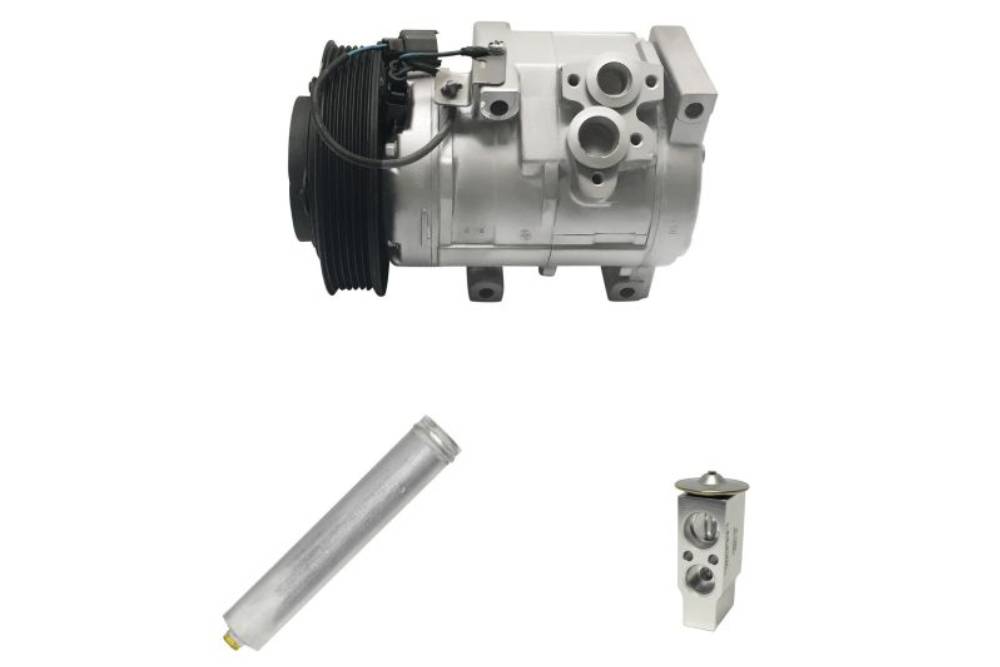
Parts Required for a Complete Repair
- AC compressor: Matched to your Accord’s year and engine
- Receiver/drier: Replace every time the AC system is opened
- Expansion valve: Replace during compressor jobs, especially if the original compressor had an internal failure
- PAG oil: Correct viscosity and quantity per Honda specifications
- Refrigerant: R-134a or R-1234yf, charged by weight to the specification on your underhood label
- O-ring kit: New O-rings for all connections
- Condenser: Replace if the compressor failed internally and released metallic debris
Labor and Access
The AC compressor on four-cylinder Accord models is accessible from the bottom of the engine bay with the vehicle raised. The V6 models (8th and 9th gen) have tighter access due to the wider engine. Typical labor time:
- Four-cylinder models: 3 to 4 hours
- V6 models: 4 to 5 hours
Replacement Cost Breakdown
| Item | Cost Range |
| Remanufactured compressor | $200 – $400 |
| New OEM compressor | $350 – $650 |
| Receiver/drier | $25 – $65 |
| Expansion valve | $25 – $60 |
| Refrigerant and oil | $40 – $80 |
| O-rings | $15 – $25 |
| Labor (3-5 hours) | $300 – $600 |
| Total (with reman compressor) | $605 – $1,230 |
| Total (with new OEM) | $755 – $1,480 |
Dealership pricing adds 30 to 50 percent above these figures, primarily from higher labor rates and OEM-only parts.
Extending the Life of Your Accord’s AC System
- Run the AC for at least 10 minutes every week, even in winter. Engaging the compressor circulates oil through the system, keeping seals conditioned and preventing dry start damage.
- Replace the cabin air filter every 15,000 miles. A clean filter ensures proper airflow across the evaporator. On the Accord, the cabin filter is behind the glove box and takes about two minutes to replace.
- Fix leaks early. A system that loses charge slowly will eventually run with insufficient refrigerant, starving the compressor of the oil it needs for lubrication.
- Do not add stop-leak products. Sealant products can clog the expansion valve and orifice tube, creating bigger problems than the leak they are meant to fix.
- Have the system inspected before summer. A quick pressure check and visual inspection in the spring can catch developing problems before they leave you without AC in July.
Frequently Asked Questions
Total replacement cost for a Honda Accord AC compressor typically runs $605 to $1,230 using a remanufactured compressor, or $755 to $1,480 with a new OEM unit. This includes the compressor, receiver/drier, expansion valve, refrigerant, O-rings, and 3 to 5 hours of labor. Dealership pricing is generally 30 to 50 percent higher than independent shop rates.
The most common causes are low refrigerant from a leak, a failed AC relay (especially on 2008–2012 models), a non-functioning condenser fan, or a compressor clutch that is not engaging. Start with the relay and fuse — on 8th-gen Accords in particular, a $15 relay swap resolves a large number of warm-air complaints before any expensive diagnostics are needed.
Yes, you can drive with a failed AC compressor as long as the compressor is not seized. A seized compressor will snap the serpentine belt, which can also disable the alternator and power steering. If the compressor is making grinding noises or the belt shows signs of stress, disengage the AC entirely and have it inspected promptly. A compressor that simply does not cool is safe to drive with the AC off.
8th and 9th generation Accords (2008–2017) use R-134a. Most 10th generation Accords (2018–2022) use R-134a on early production models, with 2020 and newer models transitioning to R-1234yf. 11th generation Accords (2023–present) use R-1234yf exclusively. Always check the underhood label on your specific vehicle before adding refrigerant.
Most Accord AC compressors last 10 to 15 years or 150,000 to 200,000 miles under normal conditions. Lifespan is heavily influenced by how often the AC is used, whether leaks are repaired promptly, and whether the system is kept properly charged. Running the AC year-round (even briefly in winter) helps preserve compressor seals and lubrication.
If the only issue is a low refrigerant charge from a small leak, a recharge may restore cooling temporarily. However, if the compressor has internal mechanical failure — indicated by abnormal pressures, grinding noises, or metallic debris in the system — a recharge will not fix it. Recharging a system with a failed compressor can also force refrigerant and debris through other components, damaging the condenser and expansion valve.
Ignoring a failing compressor typically leads to one of two outcomes: the system gradually loses all cooling ability as refrigerant escapes or the compressor stops functioning, or the compressor seizes internally and destroys the serpentine belt. The second scenario is significantly more expensive, as belt replacement and inspection of all belt-driven accessories (alternator, power steering pump, water pump) adds cost and labor to the repair.
Find Your Honda Accord AC Compressor at R & Y A/C Compressors
R & Y A/C Compressors carries AC compressors for every generation of the Honda Accord, from the 8th-gen through the latest models. Based in Miami since 1989, we offer both remanufactured and new compressors that are tested for performance and backed by our warranty. Browse our selection at rycompressors.com or contact our team to get the right compressor and components for a complete, reliable repair of your Accord’s AC system.