
*By the AC Specialists at R & Y A/C Compressors | Family-owned and operated in Miami, FL since 1989 | Last updated: March 2026*
Quick Answer:
The AC condenser is the radiator-like component behind your front grille that converts hot refrigerant gas into a liquid by releasing heat to outside air. It fails from road debris punctures, internal blockage after a compressor failure, or corrosion. Leaking or internally blocked condensers must be replaced — AC stop-leak products are not a reliable fix and can damage other components.
The AC condenser is one of the most exposed and vulnerable components in your car’s air conditioning system. Mounted right in front of the radiator, it takes a beating from road debris, salt, and weather every single day. When it fails, your AC stops cooling — and in most cases, the only fix is replacement.
This guide covers everything you need to know about the AC condenser: what it does, how it fails, and what to expect when it is time for a new one.
What Does the AC Condenser Do?
To understand the condenser, it helps to know the basics of how your car’s AC system works.
Your AC system circulates refrigerant in a continuous loop. The compressor pressurizes the refrigerant into a high-pressure, high-temperature gas. That hot gas needs to be cooled down and converted into a liquid before it can absorb heat from your cabin.
That is exactly what the condenser does.
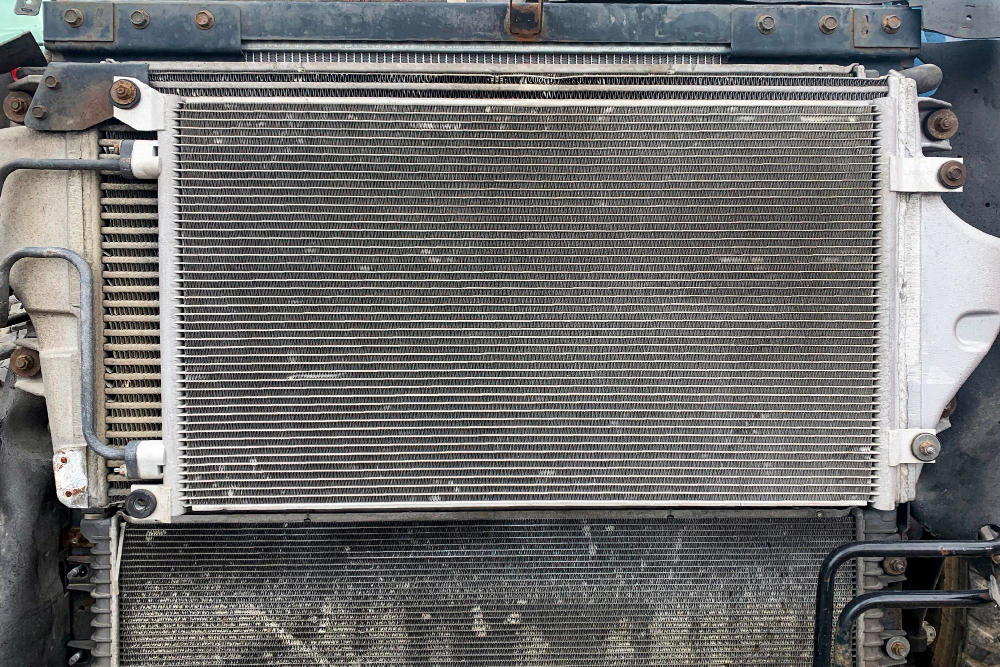
The condenser looks like a smaller radiator and sits directly in front of your engine’s cooling radiator. As the hot refrigerant gas flows through the condenser’s thin tubes and fins, air passing over the condenser (from driving or from the cooling fan) removes heat. This causes the refrigerant to condense from a gas into a high-pressure liquid.
From there, the liquid refrigerant moves on to the expansion valve or orifice tube, where it drops in pressure and temperature before entering the evaporator to cool your cabin air.
Why Location Matters
The condenser’s position at the very front of your vehicle is critical for heat dissipation, but it also makes it the most vulnerable AC component. It is exposed to:
- Rocks, gravel, and road debris
- Salt spray in winter climates
- Bug impacts and buildup
- Minor front-end collisions
- Corrosion from moisture and chemicals
This constant exposure is why condenser failure is one of the most common AC repairs.
Common AC Condenser Problems
Refrigerant Leaks
Leaks are the number one reason condensers fail. The thin aluminum tubes and fins are susceptible to damage from road debris impacts and corrosion over time.
Signs of a condenser leak include:
- Gradually declining AC performance. If your AC works great after a recharge but slowly loses cooling over weeks or months, a small leak is likely.
- Visible oily residue on the condenser surface. Refrigerant oil travels with the refrigerant, so a leak often leaves an oily stain where the refrigerant escapes.
- AC stops working after a front-end impact, even a minor one. A stone chip or minor fender bender can puncture a condenser tube.
Small leaks can sometimes be hard to find visually. A shop will typically use a UV dye test or an electronic leak detector to pinpoint the source.
Blockages and Restrictions
Over time, debris can accumulate inside the condenser tubes, restricting refrigerant flow. This is especially common after a compressor failure, when metallic particles from the damaged compressor circulate through the system and lodge in the condenser’s narrow passages.
Symptoms of a blocked condenser include:
- Higher-than-normal high-side pressure readings.
- Reduced cooling performance even though the system is fully charged.
- Compressor cycling off on the high-pressure switch due to excessive pressure.
A blocked condenser usually cannot be flushed effectively and needs to be replaced.
Physical Damage
Bent fins, crushed tubes, and impact damage from rocks or collisions can compromise the condenser’s ability to transfer heat. Even if the condenser is not leaking, significant fin damage reduces airflow and cooling efficiency.
Look for:
- Visible dents, bends, or crushed sections on the condenser face.
- Areas where fins are flattened or missing.
- Damage concentrated in one area (often the lower portion, which is most exposed).
Minor fin damage can sometimes be straightened with a fin comb, but tube damage or widespread fin loss usually means replacement.
Corrosion
Aluminum condensers are resistant to corrosion, but they are not immune. Salt exposure, chemical road treatments, and general weathering can cause corrosion over years of service. Corrosion weakens the tube walls and eventually leads to leaks.
Vehicles in coastal areas or northern climates with heavy road salt use are especially prone to condenser corrosion.
When Should You Replace the AC Condenser?
Replace your condenser if:
- It has a confirmed refrigerant leak. Condenser leaks cannot be reliably repaired. The thin aluminum construction does not lend itself to welding or patching, and stop-leak products can cause more problems than they solve by clogging other components.
- It is internally blocked after a compressor failure. If your compressor failed and sent debris through the system, the condenser almost certainly needs to be replaced to prevent the new compressor from failing.
- It has significant physical damage from an impact or collision.
- It has widespread corrosion that is likely to cause leaks in the near future.
Can You Repair a Leaking Condenser?
In most cases, no. Unlike a radiator, which can sometimes be soldered or repaired, AC condensers operate at much higher pressures and use very thin-walled tubes. Repair attempts are rarely reliable and can lead to repeat failures.
AC stop-leak products are also not recommended. While they may temporarily seal a small leak, they can clog the expansion valve, orifice tube, and other small passages in the system, leading to far more expensive repairs down the road.
Replacement is almost always the better long-term solution.
AC Condenser Replacement: What to Expect
The Process
Condenser replacement is a straightforward job for an experienced technician or a confident DIYer. Here is the general process:
- Recover the refrigerant using an approved recovery machine. Never vent refrigerant to the atmosphere.
- Remove the front bumper or grille (on many vehicles) to access the condenser.
- Disconnect the refrigerant lines from the condenser.
- Remove the mounting hardware and any brackets or components blocking access.
- Remove the old condenser and install the new one.
- Replace the receiver drier or accumulator. This is mandatory any time the system is opened to the atmosphere.
- Replace all O-rings at the connection points with new ones lubricated with refrigerant oil.
- Evacuate the system with a vacuum pump to remove air and moisture.
- Recharge with the correct amount of refrigerant and add any required compressor oil.
- Test the system for proper operation and check for leaks.
How Long Does It Take?
Most condenser replacements take 2 to 4 hours, depending on the vehicle. Some vehicles require removing additional components like the headlights, fan assembly, or intercooler for access.
How Much Does AC Condenser Replacement Cost?
- Condenser (parts only): $80 to $300 for most vehicles, depending on application and quality.
- Receiver drier / accumulator: $20 to $60.
- Labor: $200 to $500 at a shop.
- Refrigerant recharge: $50 to $150.
- Total shop cost: $350 to $900 for most vehicles.
DIYers can save significantly on labor, but you will need a refrigerant recovery machine and vacuum pump, or access to a shop that can handle the recovery and recharge.
Tips for Choosing a Replacement Condenser
When shopping for a replacement condenser, keep the following in mind:
- Match the OE specifications. Make sure the replacement has the same tube and fin configuration, mounting points, and line connections as the original. A condenser that does not match can result in poor performance or fitment issues.
- Consider parallel-flow designs. Most modern condensers use a parallel-flow design with flat multi-channel tubes, which is more efficient than the older serpentine-tube design. If your vehicle originally had a serpentine condenser, upgrading to a parallel-flow design can improve cooling performance.
- Check for included components. Some condensers come with the receiver drier already attached (called an integrated condenser). If yours has an integrated drier, make sure the replacement includes it.
Frequently Asked Questions
Signs include gradually declining AC performance after a recent recharge, oily residue on or around the condenser (refrigerant leaks carry compressor oil), and AC failure after even a minor front-end impact. A shop can confirm a condenser leak with UV dye or an electronic leak detector.
Yes, but your AC will not work properly and will continue losing refrigerant. The refrigerant loss itself does not cause immediate engine problems, but running the AC with low refrigerant can damage the compressor over time. Fix the condenser promptly.
Very often, yes. When a compressor fails internally, it sends metallic debris through the entire AC system, including the condenser. This debris clogs the condenser’s narrow passages and cannot be flushed out reliably. Installing a new compressor with a contaminated condenser almost always leads to premature failure of the new compressor.
AC stop-leak products can temporarily seal a leak but tend to clog the expansion valve, orifice tube, and other small passages in the system. This can cause additional expensive failures. The condenser’s thin-walled aluminum tubes also do not respond well to stop-leak treatments. Replacement is the reliable fix.
Total shop cost including parts (condenser + receiver drier), labor, and refrigerant recharge typically runs $350 to $900 for most vehicles. The condenser itself costs $80 to $300 depending on the application.
Most condensers last 10 to 15 years or more with normal use. Vehicles in coastal areas or northern climates with heavy road salt exposure may see shorter lifespans due to corrosion. Road debris impacts can shorten condenser life regardless of climate.
A confident DIYer can handle condenser replacement — the mechanical work is not extremely complex. However, you need professional refrigerant recovery equipment (or access to a shop that can recover and recharge the system). It is illegal to vent refrigerant to the atmosphere. Many DIYers do the mechanical work and pay a shop for the refrigerant service.
Protect Your Investment
After installing a new condenser, protect it by keeping the front of the vehicle clean, removing bug and debris buildup regularly, and addressing any AC issues promptly before they cascade into bigger problems.
At R & Y A/C Compressors, we carry new condensers for a wide range of vehicles, all built to meet or exceed OE specifications. As a family-owned and operated auto AC parts supplier in Miami since 1989, we understand the importance of quality parts and honest advice. Enter your year, make, and model at rycompressors.com to find the right condenser for your vehicle or contact us for help finding the right part for your vehicle.